


An industrial robot refers to a multi-jointed manipulator or multi-degree-of-freedom mechanical device for industrial use. It can perform tasks automatically and realize various functions relying on its own power and control capability. It can accept human instructions or operate according to pre-programmed routines. Modern industrial robots can also act in accordance with principles formulated by artificial intelligence technologies.
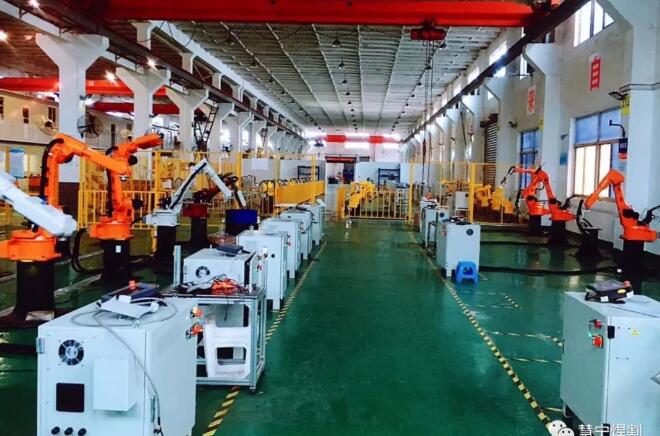
Robots are becoming increasingly intelligent and playing an ever more important role in manufacturing enterprises. Advanced IT and automation technologies drive innovation in the manufacturing sector to achieve "intelligent manufacturing", improve efficiency and cut costs.
I. Development Background of Industrial Robots
The term "Robot" was coined by a Czech playwright in 1920. Robots have evolved for nearly a century ever since. The evolution ranges from early industrial robots merely for material handling, to the second-generation industrial robots equipped with visual sensors and information processing technology, and to the "intelligent robots" currently under research. The development and application of industrial robots advance with each passing day.
II. Application Scenarios of Industrial Robots
Over just more than 50 years, robotics technology has achieved rapid development. Among various manufacturing sectors, the automotive and auto parts industries see the widest application of industrial robots, and their adoption keeps expanding into other fields, including machining, electronics and electrical engineering, rubber and plastics, food processing, timber and furniture manufacturing.
In industrial production, various industrial robots such as welding robots, grinding and polishing robots, laser processing robots, painting robots, handling robots and vacuum robots have been widely deployed.
1. Grinding and Polishing Robots
Robotics technology has developed rapidly in over 50 years. Grinding and polishing robots are mainly used for grinding and polishing of aero, marine and nuclear power turbine blades. A robot holds an abrasive belt to polish blade surfaces. Flexible contact and visual positioning are adopted to reduce polishing defects.
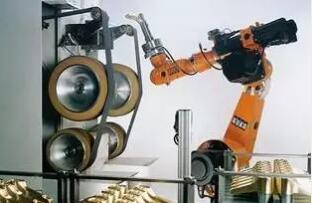
Compared with manual grinding and polishing, it features shorter processing time, high profile accuracy, low surface roughness and excellent processing consistency. It can handle heavy loads and adapt to harsh working environments with high precision requirements.
2. Welding Robots
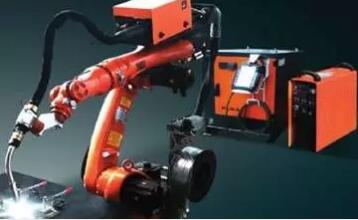
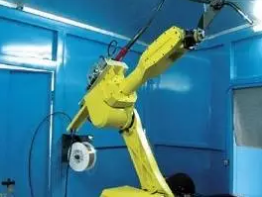
Arc welding robots are mainly used for welding production of various auto parts, including two types: metal active gas welding and non-consumable electrode welding.
In this field, major international industrial robot manufacturers mainly supply unit products to complete equipment suppliers. Application features: fast and smooth movement is required with high positioning accuracy.
3. Laser Processing Robots
Laser processing robots integrate robotic technology into laser processing. High-precision industrial robots enable more flexible laser processing operations.
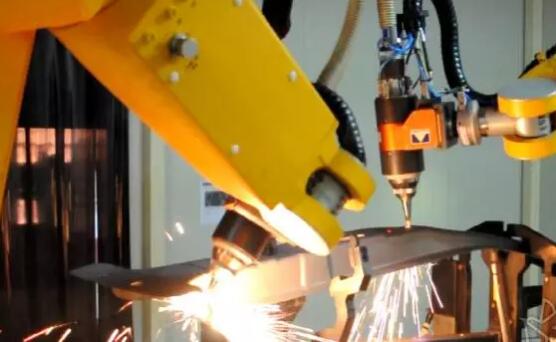
It can automatically detect workpieces, generate workpiece models and then create machining paths, or directly perform machining using CAD data. It is applicable to laser surface treatment, drilling, welding and mold repair of workpieces, requiring high precision.
4. Vacuum Robots
A vacuum robot is a robot operating in a vacuum environment. It is mainly used in the semiconductor industry to transfer wafers inside vacuum chambers.
Vacuum manipulators are difficult to import and subject to import restrictions. Featuring large consumption volume and high versatility, they have become key components restricting the R&D progress and product competitiveness of complete semiconductor equipment. High precision is required.
5. Painting Robots
Painting robots are generally hydraulically driven. They boast fast movement speed and good explosion-proof performance. Teaching can be realized through lead-through teaching or point-to-point programming.
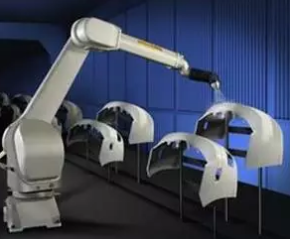
Painting robots are widely used in manufacturing sectors such as automobiles, instruments, electrical appliances and enamel products. Spraying robots work in harsh environments and require relatively low precision.
6. Handling Robots
Handling robots are computer-controlled and equipped with functions including movement, automatic navigation, multi-sensor control and network interaction. They are widely adopted for flexible handling and transportation across various industries, and also deployed in automated stereoscopic warehouses, flexible machining systems and flexible assembly systems.
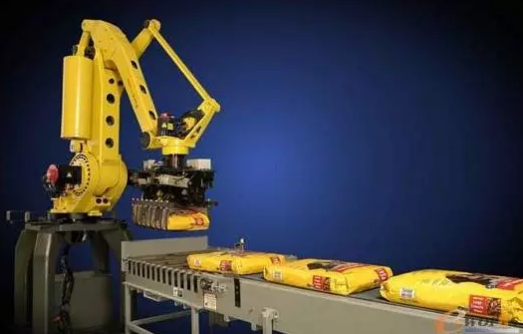
Meanwhile, they can serve as transport tools for goods sorting at stations, airports and post offices. They feature heavy load capacity without strict precision requirements.
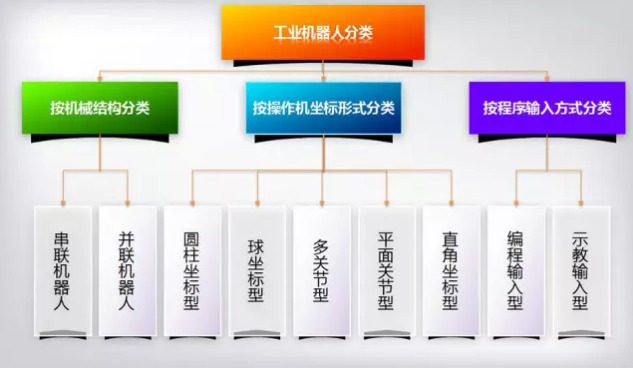
III. Classification of Industrial Robots
IV. Performance Evaluation Indicators of Industrial Robots
The basic parameters and performance indicators that characterize robot features mainly include workspace, degrees of freedom, payload, motion accuracy, motion characteristics and dynamic characteristics.
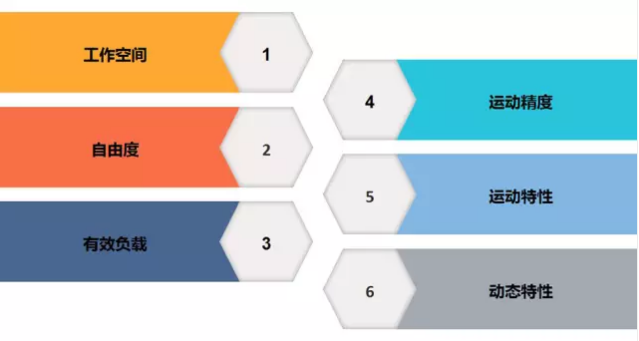
▲ Performance Evaluation Indicators of Industrial Robots
Work space The workspace refers to the set of all spatial positions reachable by a specific part of the robot arm under given conditions. The shape and size of the workspace reflect the working capacity of the robot.
Degrees of Freedom of Motion Degrees of freedom of motion are the number of variables required for the robot manipulator to move in space. It is a parameter representing the flexibility of robot movement, generally expressed as the number of independent translational motions along axes and rotational motions around axes.
A free object has six degrees of freedom in space (three rotational degrees of freedom and three translational degrees of freedom). An industrial robot is usually an open-linkage system, and each joint pair has only one degree of freedom. Therefore, the number of degrees of freedom of a robot is normally equal to its number of joints. The more degrees of freedom a robot has, the stronger its functions.
Payload Payload refers to the weight of an object that can be carried by the end of the robot arm during operation, or the force and torque it can withstand. It indicates the load capacity of the manipulator.
The maximum permissible handling mass varies with different postures of the robot. Thus, the rated handling mass of a robot is defined as the maximum mass that can be carried at the end of the wrist at any posture of the arm within the workspace.
Motion Accuracy The accuracy of a robot’s mechanical system mainly involves pose accuracy, repeat pose accuracy, path accuracy and repeat path accuracy.
Pose accuracy is the deviation between the commanded pose and the center of the actual attained pose when approaching the commanded pose from the same direction. Repeat pose accuracy refers to the inconsistency of attained poses after n repeated responses to the same commanded pose from the same direction.
Path accuracy describes how closely the robot mechanical interface follows the commanded path n times from the same direction. Repeat path accuracy means the inconsistency among attained paths after n runs along a given path in the same direction.
Motion Characteristics (Speed) Speed and acceleration are primary indicators reflecting robot motion characteristics. Robot datasheets usually list the maximum steady speed for major degrees of freedom. In practical applications, merely considering the maximum steady speed is insufficient; the maximum allowable acceleration should also be taken into account.
Dynamic Characteristics Structural dynamic parameters for dynamic characteristics mainly include mass, moment of inertia, stiffness, damping coefficient, natural frequency and vibration mode.
V. Comprehensive Interpretation of Industrial Robots
1. Current Status of Industrial Robots in China
Industrial robots have achieved rapid growth in the Chinese market for the following reasons:
First, in terms of cost, the operating cost of a robot is generally only one quarter of labor cost.
Second, robots can generate many additional values in quality, efficiency, management and other aspects.
Therefore, driven by combined factors including rapid advancement of robot technology, sharp price drops, labor shortage and rising labor costs, China’s industrial robot industry is in an era of explosive growth.
2. Key Technologies of Industrial Robots
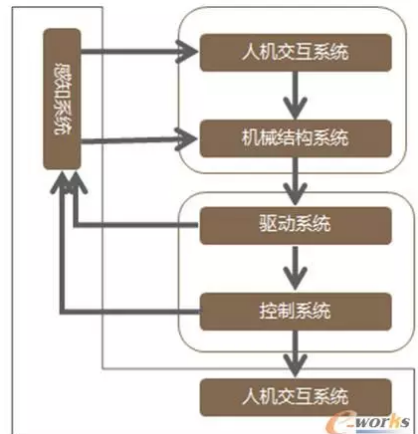
An industrial robot consists of 3 major parts and 6 subsystems. The three major parts are mechanical part, sensing part and control part. The six subsystems include mechanical structure system, drive system, perception system, robot-environment interaction system, human-machine interaction system and control system.
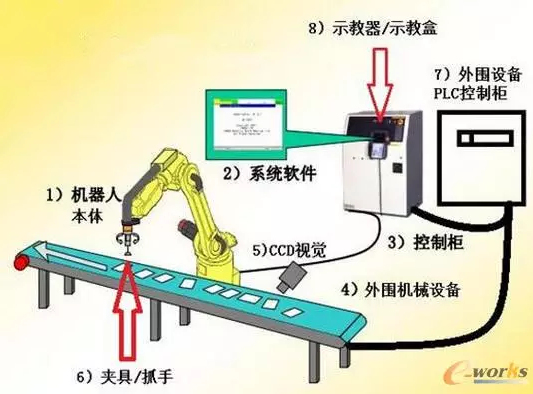
The key basic components of robots are mainly divided into three categories: high-precision reducers, high-performance AC/DC servo motors and drives, and high-performance controllers. Robot performance indicators mainly include workspace, degrees of freedom, payload, motion accuracy, motion characteristics and dynamic characteristics.
3. Technical Challenges Faced by Industrial Robots
Although robot technology has made remarkable progress in recent years, we should clearly recognize the huge challenges confronting the development of China’s industrial robot industry.
Industrial Robot Equipment Intelligent robots are increasingly involved in human production and daily life. Artificial intelligence technology enjoys strong momentum and promising prospects. China has the fastest-growing robot market worldwide and has become the world’s largest market for industrial robots.